
This year, design isn’t just about what looks visually stunning—it’s about how things feel, how they adapt, and how they connect with us on a human level. Whether you are building a product, designing a brand, or coding a website, here are the top design trends shaping UI/UX, graphic design, and emerging tech in 2026.
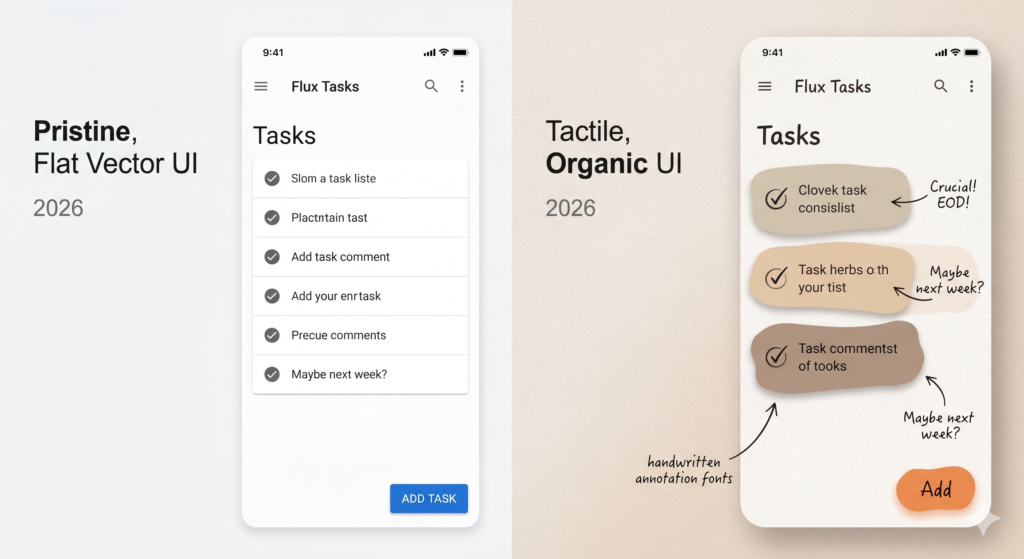
1. “Imperfect by Design” & The Tactile Revival
After years of hyper-polished, pixel-perfect interfaces (a trend accelerated by AI image generation), the pendulum has swung back toward humanity. We are seeing a massive rise in “Imperfect by Design.” This means embracing raw, tactile textures—think digital grain, paper-like surfaces, hand-drawn typography, and scrapbook-style layering. It’s about breaking the synthetic feel of the web and making digital spaces feel real, relatable, and perfectly imperfect.
2. Organic Shapes and Anti-Grid Layouts
The strict, rigid grids that dominated the 2010s and early 2020s are softening. In 2026, web design flows. We are seeing fluid lines, organic shapes, and “anti-grid” layouts that introduce a natural rhythm and playfulness to websites. Combined with soft, multi-layered gradients in earthy tones (like clay, moss, and sand), these layouts guide the user’s eye organically rather than forcing them into rigid boxes.
3. Spatial UI and “Liquid Glass”
With spatial computing hardware becoming mainstream, spatial design has moved from an experiment to a standard requirement. Even on flat 2D screens, we are creating the illusion of depth. “Liquid Glass” and transparent materials are everywhere, using shadows, highlights, and blurs to create visual hierarchy. It’s a responsive 3D approach that actually feels alive, allowing users to see the context of the background while focusing on the foreground.
4. AI as a Collaborative Partner (Not Just a Tool)
AI is no longer just a side tool for generating text or images; it is woven into the very fabric of the UX process. We’re seeing the rise of “Agentic Web Experiences” where interfaces adapt in real-time based on user behavior. Websites are no longer static digital brochures; they are hyper-personalized, context-aware environments that anticipate what the user needs before they even click.
5. Multimodal Interfaces
Touch and type are no longer enough. In 2026, users are moving constantly between quiet homes, noisy commutes, and open offices. To adapt, interfaces are becoming multimodal—fluidly combining touch, voice commands, and gesture controls. UX design now requires planning for how a user might seamlessly switch from tapping a screen to speaking a command without breaking the experience.
6. Minimalist Maximalism
Minimalism isn’t dead, but it has evolved. Enter “Minimalist Maximalism”—where visual overload is intentionally contained within strong grid systems and generous negative space. It’s about combining the clarity and calm of minimalism with sudden bursts of rich layering, vibrant colors, or highly expressive typography. It gives brands a distinct personality without causing cognitive overload.
7. Ethical, Inclusive, and Sustainable Design
Finally, great design in 2026 is responsible design. Accessibility is no longer an afterthought; it’s the baseline. High-contrast colors for legibility, neurodiversity-aware layouts to reduce cognitive load, and inclusive multimodal options are standard. Furthermore, sustainable design—optimizing code, using darker modes, and compressing assets to reduce the carbon footprint of digital products—is a growing priority for top-tier agencies.
If 2026 is teaching us anything, it’s that technology works best when it serves humanity, not the other way around. The future of design is tactile, adaptive, and deeply personal.